
2026 AOFAS/NZFAS Annual Conference - Singapore, August 2026
Reflections from AOFAS & NZFAS 2026 in Singapore: Global Perspectives in Foot and Ankle Surgery
I have just returned from the 2026 Combined Australian Orthopaedic Foot & Ankle Society (AOFAS) and New Zealand Foot and Ankle Society (NZFAS) Conference, held at the Hilton Singapore Orchard from Thursday 13 to Sunday 16 August. It was a privilege to attend, to learn, and to share ideas with colleagues from around the world. This was a genuinely international meeting — Australia and New Zealand hosting, with the British Orthopaedic Foot & Ankle Society, the Singapore Orthopaedic Association and the South African Foot Surgeons Association joining as guest societies. Four days on Orchard Road delivered exactly what a meeting of this kind should: case-based discussion, live debate, and honest conversation about where our specialty is heading, rather than a procession of slide decks.
A Strong Showing from Melbourne Orthopaedic Group and Western Health
It was a good meeting for Melbourne. Colleagues from Melbourne Orthopaedic Group and Western Health were well represented across the scientific program, and it is genuinely satisfying to see work from our own units holding its own on an international podium.
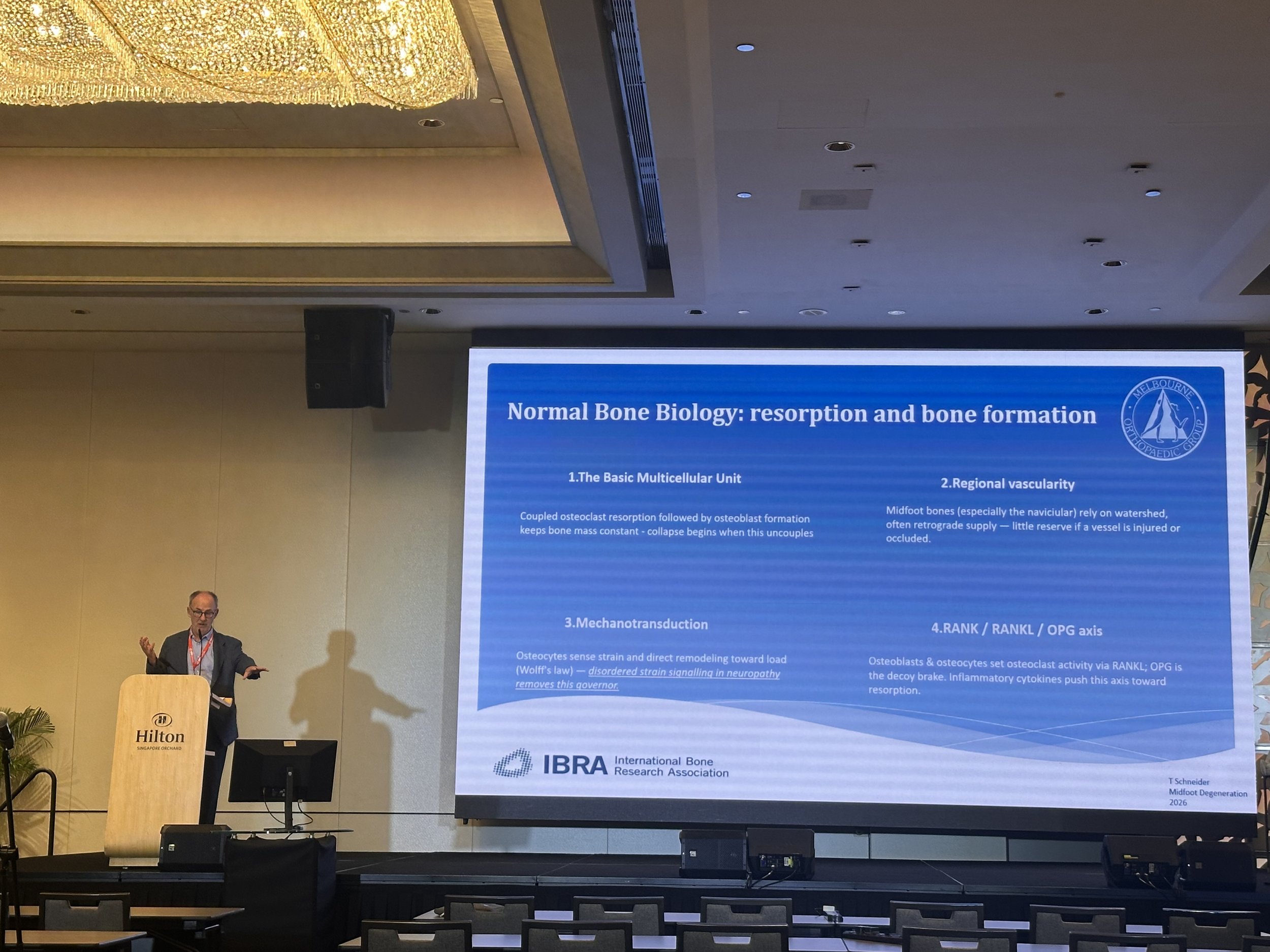
Tim Schneider presented on midfoot collapse — a problem that is under-recognised and too often managed as though it were simple midfoot arthritis. The difference between a good and a poor result usually comes down to recognising the pattern of deformity early and correcting the alignment properly, rather than treating the pain in isolation. In addition to addressing the underlying biology.
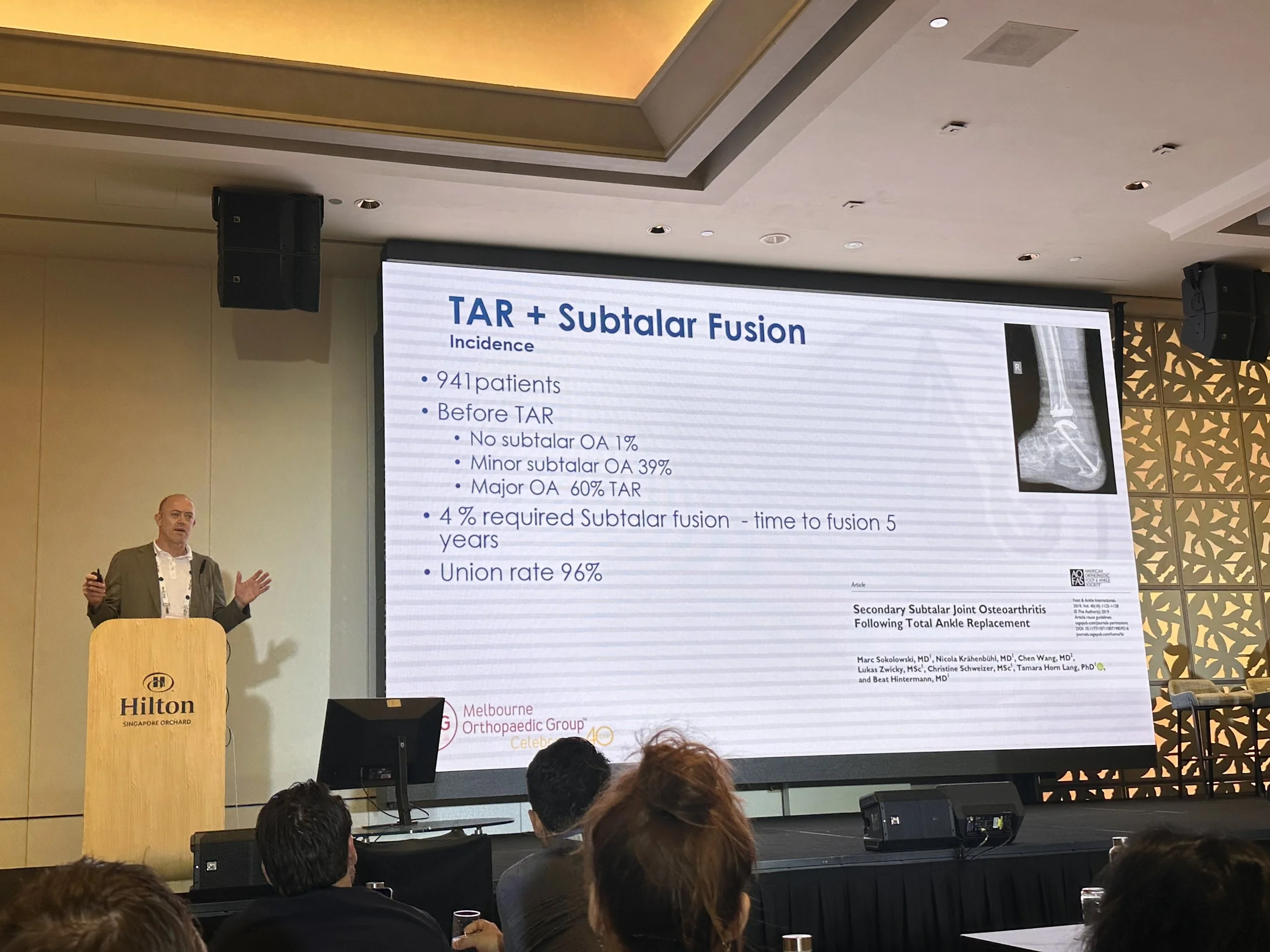
David Shepherd spoke on ankle arthrodesis takedown: converting a previously fused ankle to a total ankle replacement. This is demanding revision surgery and not for everyone, but in carefully selected patients with a stiff, fused ankle and progressive arthritis developing in the neighbouring joints, restoring movement can meaningfully change day-to-day function.
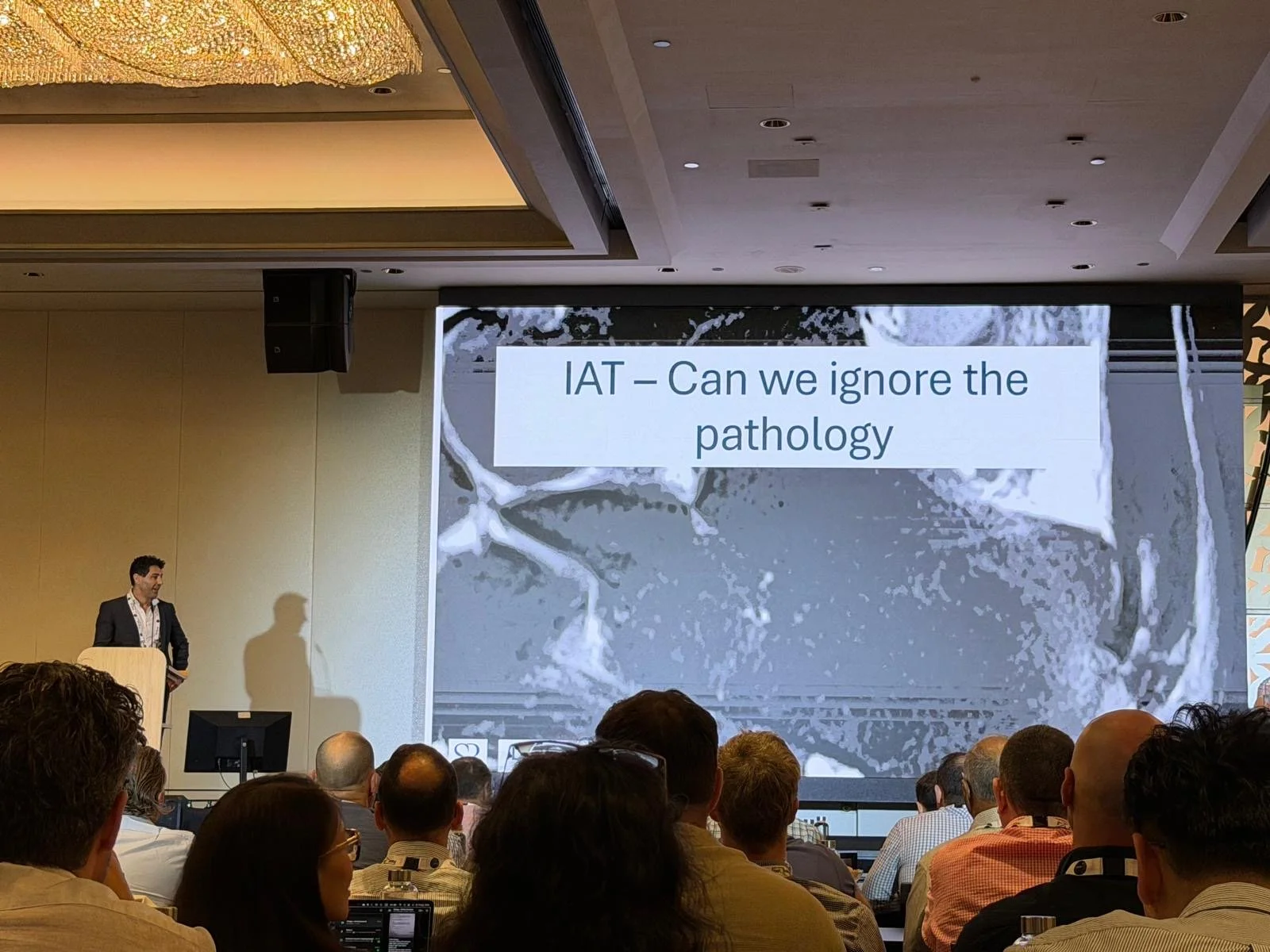
Sasha Roshan-Zamir took part in a debate with Robbie Ray (London, UK) on the surgical management of insertional Achilles tendinopathy — one of the most topical areas in our field. Zadek osteotomy has recently seen a resurgence, but debate remains whether this operation is superior to the traditional tendon takedown and reattachment. Debates like this are worth far more than a consensus statement, because they expose the reasoning behind each position.
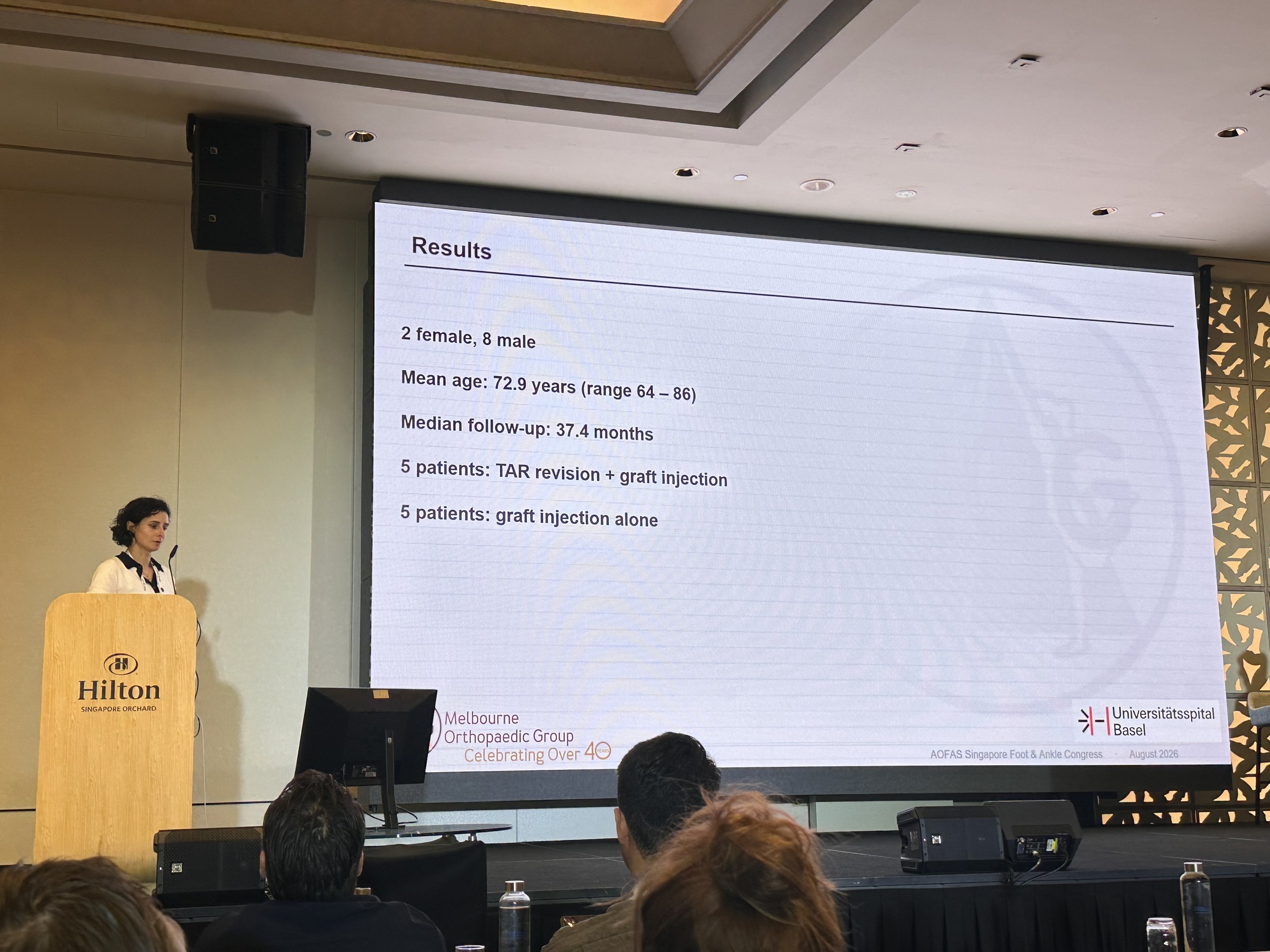
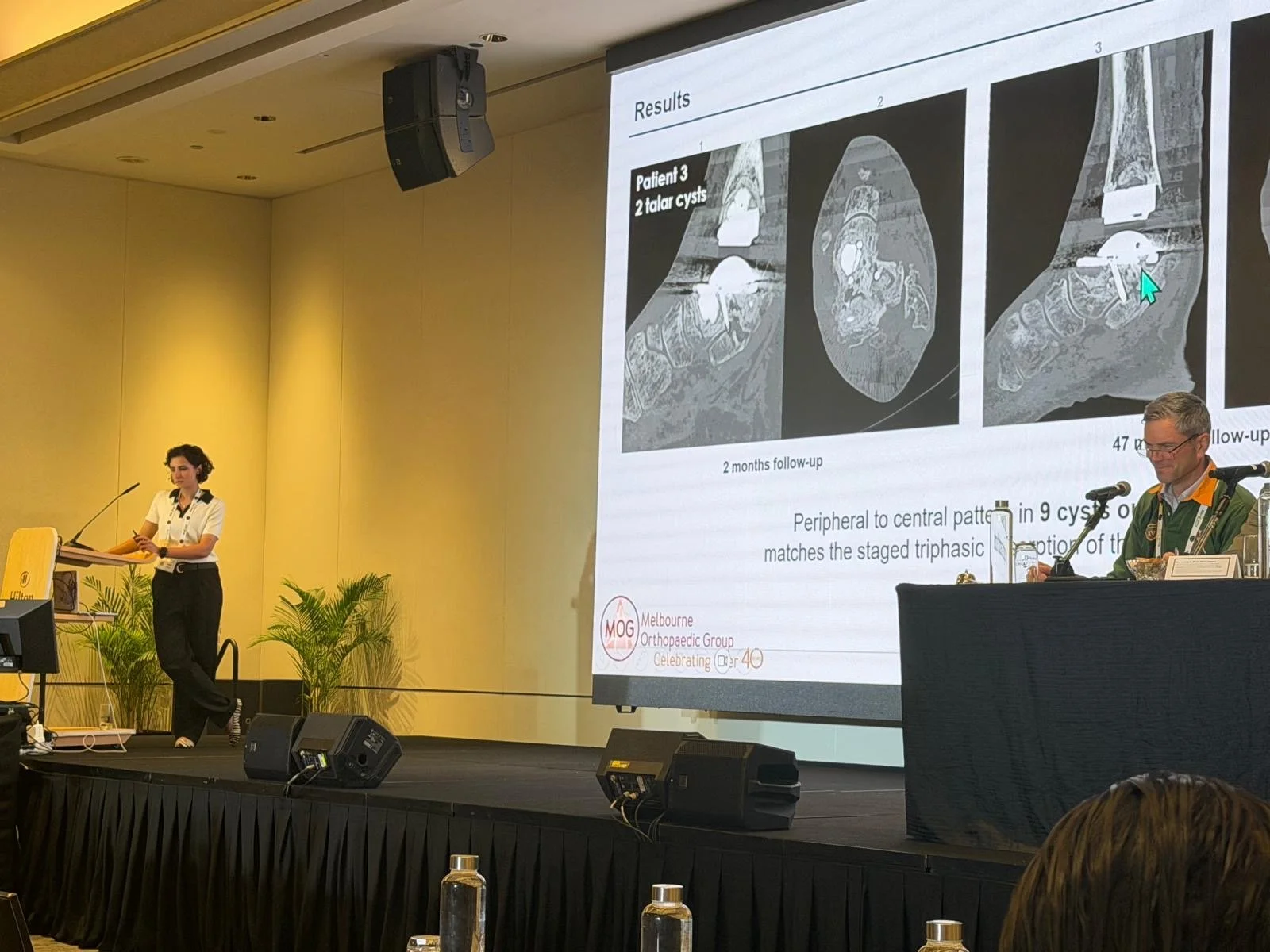
Edina Vacariu - one of our previous fellows presented a very nice study on injectable synthetic bone grafting of total ankle replacement periprosthetic bone cysts and did a terrific job of showcasing some of the important work we are doing at Melbourne Orthopaedic Group.
Presenting Our Data on Gender Representation
My own presentation looked at gender representation at European foot and ankle conferences — work that grew out of my fellowship at the Nuffield Orthopaedic Centre in Oxford with Rick Brown. We examined who occupies the podium at major meetings: invited faculty, session chairs and podium presenters and compared this to the academic authorship in both European and British journals over the same time period.
Conference platforms are not merely ceremonial. Speaking invitations shape research collaborations, referral networks and, over time, who trainees see when they picture a foot and ankle surgeon. Counting is the necessary first step, because it converts an impression into a measurable baseline that can be tracked, discussed and acted upon. Presenting the work to an international audience in Singapore was a useful test of whether the same questions travel across regions — and the discussion afterwards suggested they do.
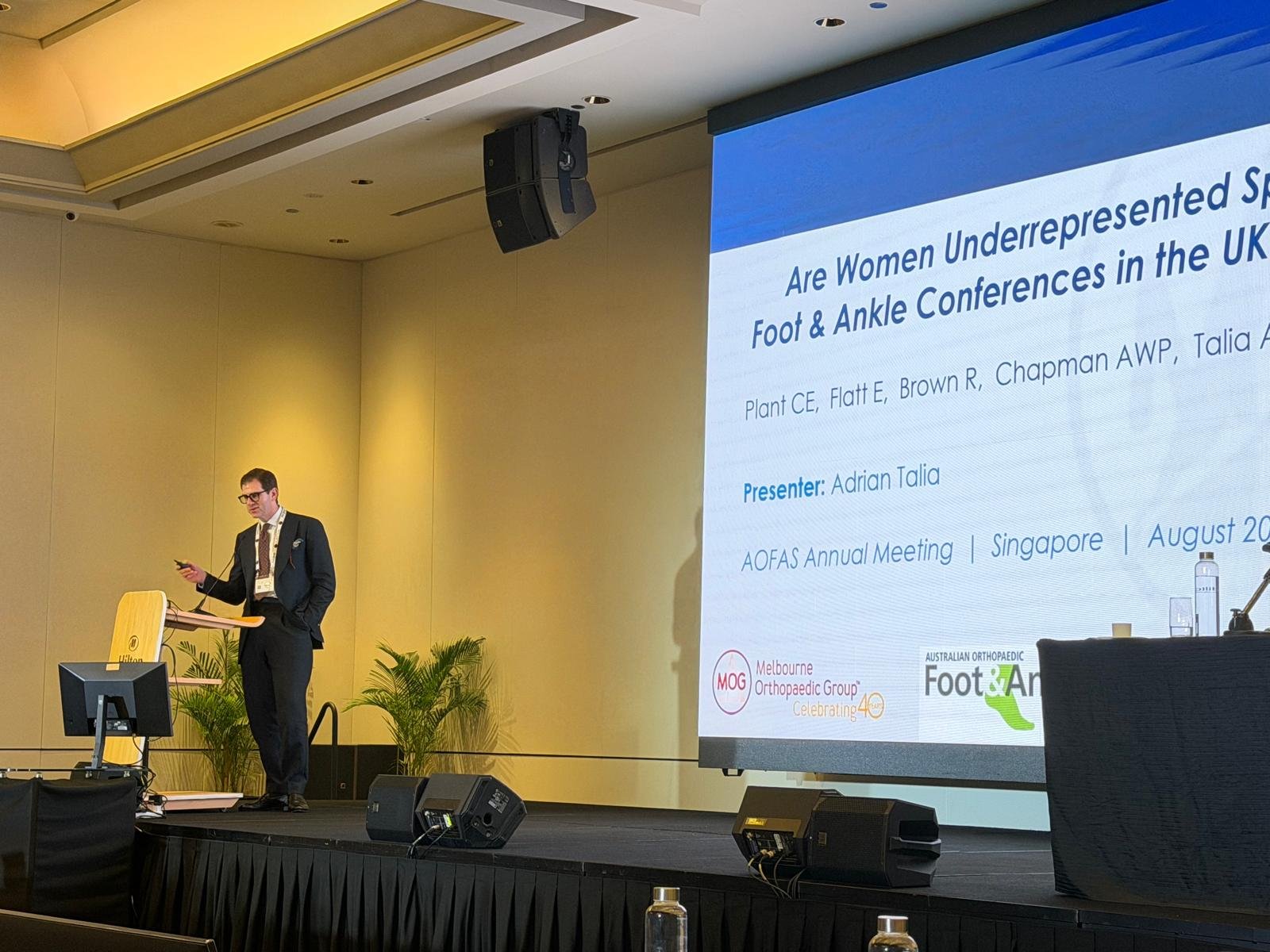
Presentation on European and British gender representation at conferences.
Two Posters from Our Research
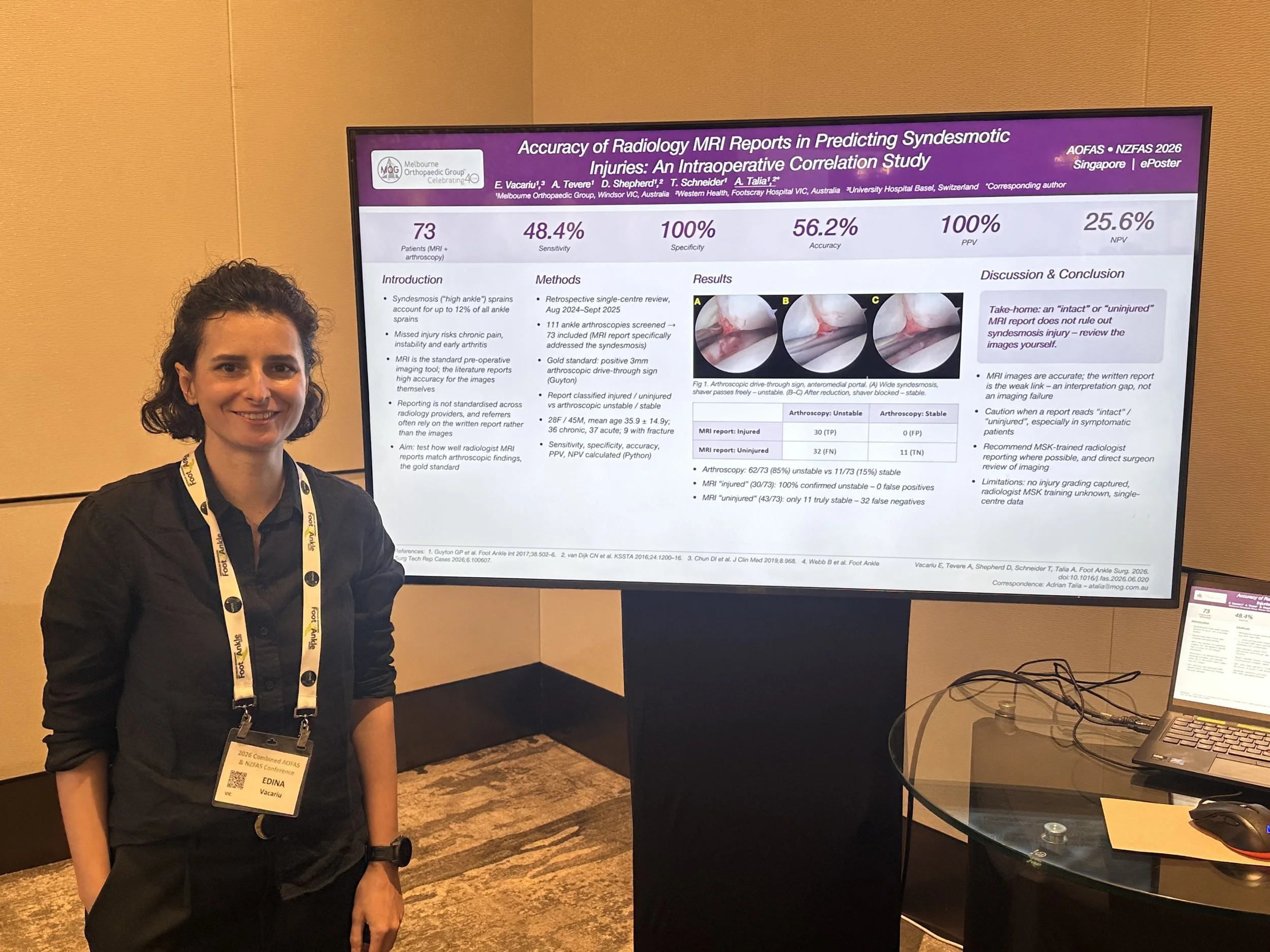
We also presented two ePosters drawn from our current research. The first, "Accuracy of Radiology MRI Reports in Predicting Syndesmotic Injuries: An Intraoperative Correlation Study", compared what the reported MRI described with what was actually found at the time of surgery. Syndesmosis (high ankle sprain) injuries are notoriously difficult to characterise on imaging alone, and the study underlines a point I make regularly in clinic: the scan report is one piece of information, not the diagnosis, and clinical assessment and intraoperative findings remain central to getting these injuries right.
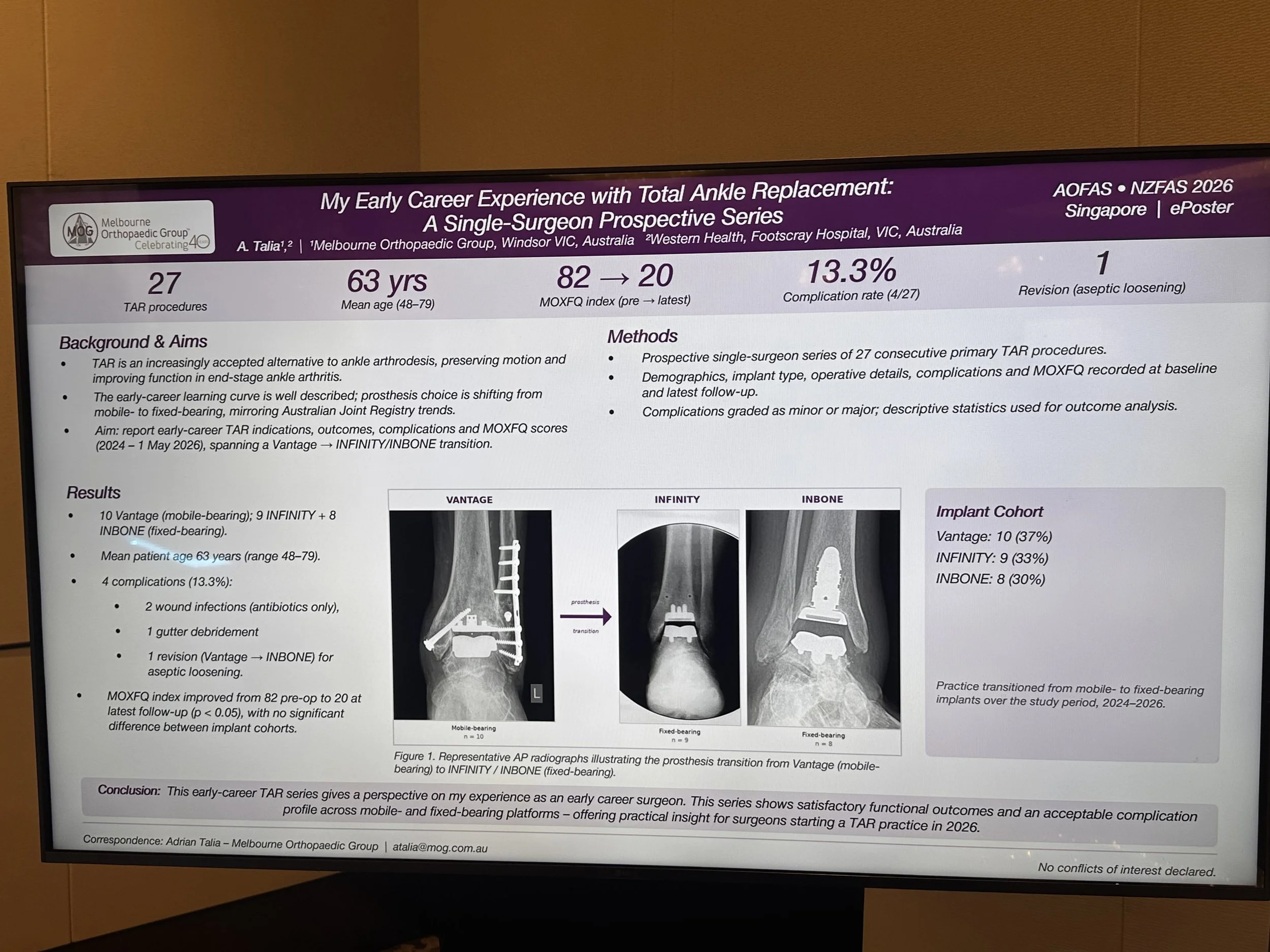
The second, "My Early Career Experience with Total Ankle Replacement: A Single-Surgeon Prospective Series", reports my own consecutive ankle replacement cases with prospectively collected outcomes. Publishing your early results honestly is uncomfortable but necessary — patients considering an ankle replacement deserve to know how their own surgeon’s cases have gone, not simply what the registry and the implant literature report.
Moderating: Biologics, the Future of Orthopaedics, and Stress Injuries
I was fortunate to be asked to moderate two sessions. The first covered biologics and the future of orthopaedics: platelet-rich plasma, bone marrow aspirate concentrate, biological augmentation of tendon and cartilage repair, and the expanding role of technology in planning and executing surgery. These are genuinely promising tools, and some will become standard practice — but patients are entitled to a frank account of what the current evidence supports and, just as importantly, what it does not yet support.
The second session addressed stress injuries. Bone stress injuries of the navicular, fifth metatarsal and medial malleolus sit at the difficult end of sports medicine, where the interesting questions are about training load, imaging thresholds, when to fix rather than rest, and how to return an athlete to sport without simply repeating the injury. Chairing that discussion with an international faculty was a highlight, and it reinforced how much variation still exists in practice around the world.
Cadaveric Teaching at the Arthrex Lab, Singapore
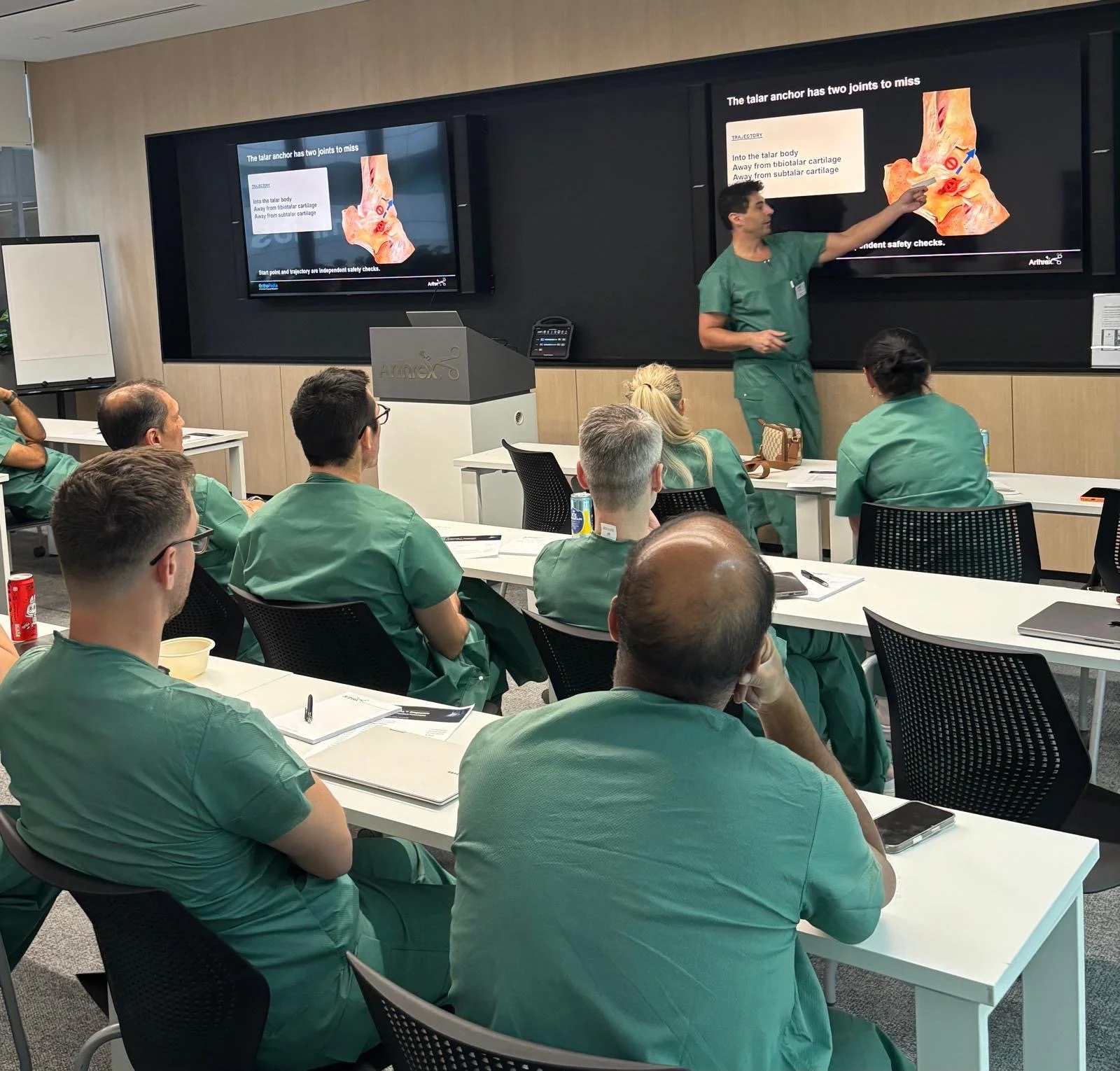
On the Wednesday before the meeting I was invited to the Arthrex laboratory in Singapore for a cadaveric course on open and minimally invasive (MIS) hindfoot pathologies. There was some excellent teaching from Sasha Roshan, Ben Beamond, Sheraz Anjum and Jorge Acevedo, working through cutting-edge techniques step by step.
Minimally invasive surgery continues to change the way a number of hindfoot procedures are performed, allowing certain osteotomies and fusions to be carried out through very small incisions with less soft tissue disruption. These techniques are not a shortcut, however: they demand a different skill set, meticulous attention to detail and a thorough understanding of the anatomy at the tip of the burr. Cadaveric time under experienced instruction remains the safest and most effective way to adopt new techniques before they reach the operating theatre.
Decision Making in Midfoot Trauma
On the Friday evening I was invited to present on behalf of Medartis on decision making in midfoot trauma, working through my own cases and the algorithms I use for midfoot injuries.
Midfoot and Lisfranc injuries are among the most consequential injuries I treat, and among the most frequently missed. A subtle Lisfranc injury on a plain X-ray can look almost normal, yet if it is not recognised and stabilised the result can be a painful, progressively deforming midfoot that is far harder to salvage later. The decisions that matter are whether to operate at all, whether to stabilise or to fuse, which fixation construct suits the injury pattern, and how the soft tissue envelope should influence timing. Presenting the reasoning behind those choices — and then having it interrogated by an experienced audience — is precisely the sort of scrutiny that improves practice.
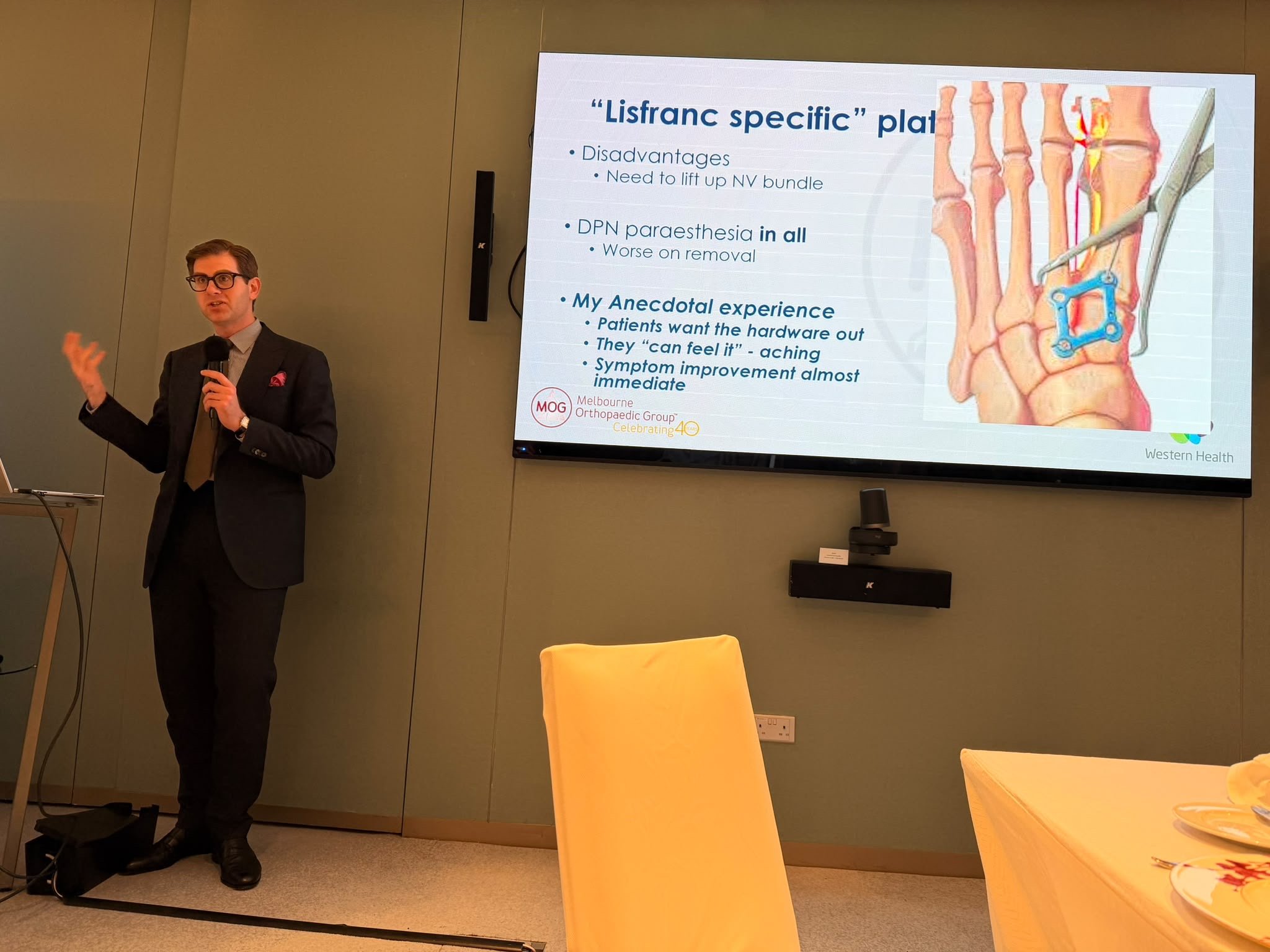
Educational dinner focusing on midfoot trauma - here I presented my treatment algorithm for lisfranc injuries from minor sprains through to full fracture/dislocations.
Why These Meetings Matter for Patients
Conferences can look, from the outside, like a professional indulgence. In reality, meetings of this calibre are where techniques are stress-tested, where results that do not fit the marketing are aired, and where you discover that a problem you find difficult is being approached differently, and sometimes better, on the other side of the world. Every one of those conversations eventually finds its way back into the clinic and the operating theatre in Melbourne. The standard of the meeting this year was exceptionally high with international guest speakers and I’ve no doubt some of that is owing to the excellent venue and organisation.
My thanks to the AOFAS and NZFAS organising committees for an outstanding program, and to my colleagues for their contributions to it. I have returned with new ideas, several new collaborations, and a longer reading list than I left with.

It was wonderful to catch up with colleagues that you haven’t seen in a long while, including my colleague and former fellowship supervisor from Oxford, Mr Rick Brown (Right). here pictured with distinguished Singaporean surgeon Dr Andrew Hong (middle).
Foot & Ankle Surgery in Melbourne
If you or a patient is dealing with a foot or ankle problem — for example ankle arthritis, instability and Achilles tendinopathy to Lisfranc and midfoot trauma — I welcome referrals to my rooms at Melbourne Orthopaedic Group in Windsor. To make a referral or enquiry, please contact my rooms on (03) 9124 7960 or email talia.admin@mog.com.au.